
Events as objects
Promotions, prices, before and after: an event is more than a dot on the calendar.
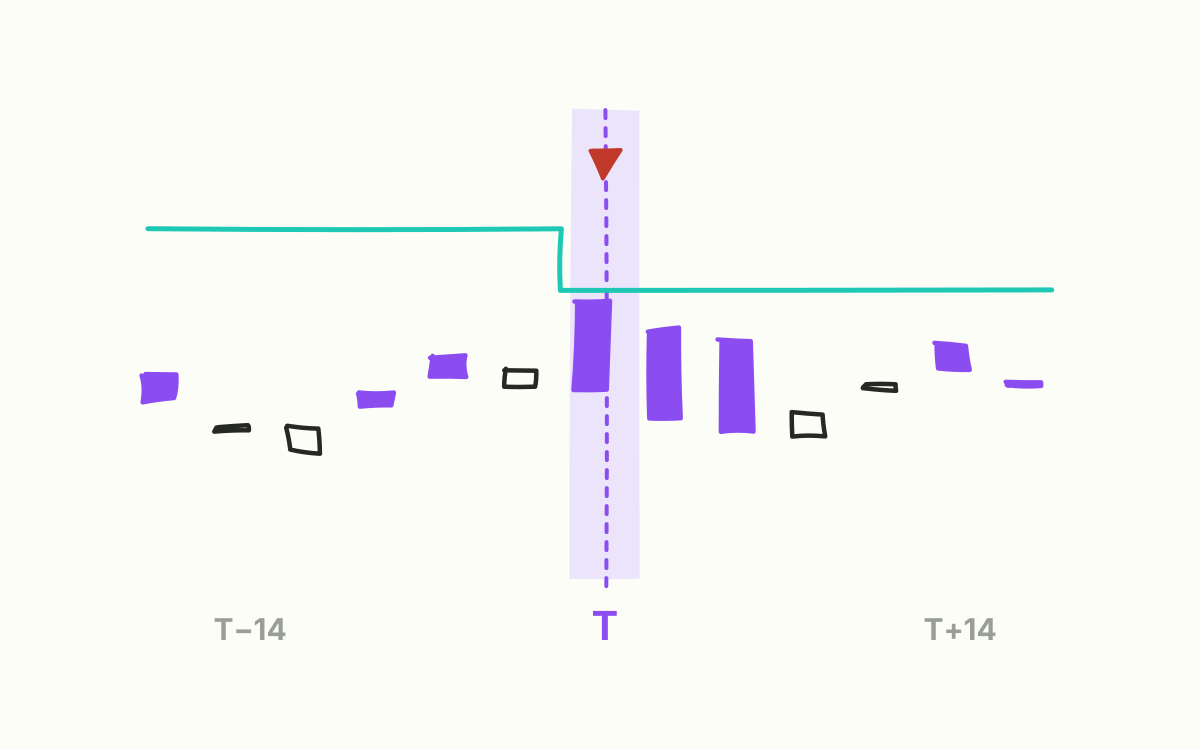
We sold considerably more on the promotion day. But wouldn’t we have anyway? And what happened afterwards – did customers just buy earlier what they would have bought later anyway? A mark on the calendar can’t answer these questions. An event can.
Events are objects, not markers
In Pythia an event is a record of its own: with a period, a type and a reference – to a channel, a range or a single item. Around 20 types in nine groups, each with a colour and a symbol: promotion days, price changes, outages and more.
Pythia calculates recurring retail days itself, many years ahead. Your own events can be created, changed and deleted. For every event you can record the occasion, such as “competition”, so that the explanation doesn’t live only in one person’s head.
Price changes Pythia finds itself
One kind of event needs no maintenance at all: price changes. Pythia detects them from the prices actually realised on receipts – per item and per channel. Every confirmed reduction or increase becomes an event with a small triangle pointing down or up.
When you look at exactly one item, the timeline shows its price per channel as a step line. Whether sales on the marketplace shifted after a price cut in your own shop is then visible at a glance.
What difference did it make?
Every event has a card showing its effect: units and revenue in the period afterwards against expectation, plus channel share and how the rest of the range developed. A control window before the event shows whether something unusual was already happening.
Pythia says what was different from expected after an event. It does not claim the event was the cause.
Notes on the card say when the statement is shaky: too little data, overlapping events, unknown occasion. Overlaps matter most – a price cut that starts on the same day as a promotion day can’t be separated cleanly, and Pythia doesn’t pretend it can.
What is still missing
Stated plainly: receipt prices are realised prices. On days without sales there is no observation. Placeholder prices of a few cents can create nonsensical events; a plausibility rule for that is planned. Also planned are price elasticity, public holidays from official sources and a filter by federal state.
Next month: what did the newsletter do? Impact per send and promo codes.